







In this bi-weekly series reviewing classic science fiction and fantasy books, Alan Brown looks at the front lines and frontiers of the field; books about soldiers and spacers, scientists and engineers, explorers and adventurers. Stories full of what Shakespeare used to refer to as “alarums and excursions”: battles, chases, clashes, and the stuff of excitement.
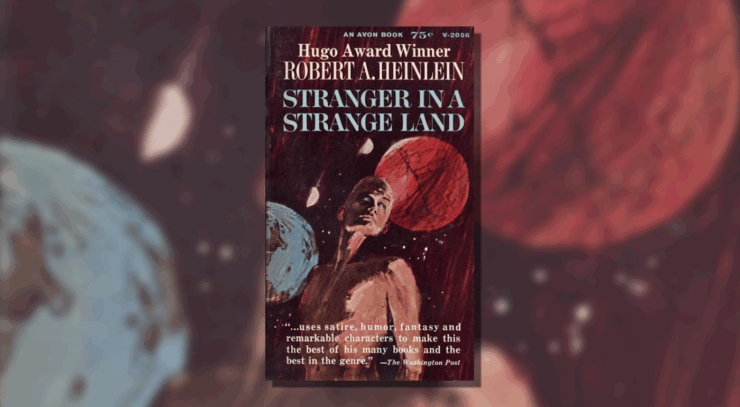
Stranger in a Strange Land is considered by many to be one of Robert Heinlein’s greatest works. I was a bit young for it when it first came out in 1961, but I read it in high school in the mid-1970s, and several times in my early twenties. The book was wildly successful, although the critical reaction was decidedly mixed. Its deconstruction of religious dogma hit a nerve in an era where the counterculture was looking for meaning from sources outside of traditional churches and mainstream society. Stranger in a Strange Land won science fiction’s Hugo Award in 1962, and was the first science fiction book to appear on The New York Times Book Review’s bestseller list. The last time I’d read it was in 1991, in my mid-thirties, when a longer, unedited version was issued. I put that edition on my shelf, and finally discarded the tattered paperback from my youth. But I later decided that the added words hadn’t improved the story, and found a used 1961 book club edition of the original version of the novel that feature a blue-green painting of the Rodin sculpture “Fallen Caryatid Carrying Her Stone,” a work much beloved by character Jubal Harshaw in the book.
While I’ve covered many Heinlein books in this column, I never reviewed Stranger in a Strange Land, feeling that its philosophical nature didn’t fit the action and adventure focus of the column. But that conviction wavered when I read the following quotation published on Facebook by the Heinlein Society a few years ago:
“If a person names as his three favorites of my books Stranger, Harsh Mistress and Starship Troopers … then I believe that he has grokked what I meant. But if he likes one—but not the other two—I am certain that he has misunderstood me, he has picked out points—and misunderstood what he picked. If he picks 2 of 3, then there is hope, 1 of 3—no hope. All three books are on one subject: Freedom and Self-Responsibility.”
The quote is drawn from the book Robert A. Heinlein – In Dialogue with His Century Volume 2: The Man Who Learned Better by William H. Patterson, Jr. And since those happen to be my three favorites of Heinlein’s books written for adults, the quote connected with me. While I‘d never thought of the three books as having a common theme, I immediately saw the point Heinlein was making. (It has been pointed out that Heinlein made this statement long before his career was over, but I am among many who feel that nothing he wrote later dislodged those books from the top three.) So, even though the book is a bit more preachy than it is action-oriented, I decided to give it a look.
Stranger in a Strange Land has been reviewed and discussed by countless writers and critics over the years, and I will try not to rehash what others have said. One of the more insightful reviews I’ve read appeared on this website, written by Jo Walton (you can find it here). I’d suggest you give it a look, as it examines some of the flaws I’ve found in the book as I’ve grown older and found myself looking at the story with a more critical eye.
About the Author
Robert A. Heinlein (1907-1988) was one of America’s most widely known science fiction authors, and is frequently referred to as the Dean of Science Fiction. I have often reviewed his work in this column, including Starship Troopers, The Moon is a Harsh Mistress, “Destination Moon” (contained in the collection Three Times Infinity), The Pursuit of the Pankera/The Number of the Beast, Glory Road, and Podkayne of Mars. From 1947 to 1958, he also wrote a series of a dozen juvenile novels for Charles Scribner’s Sons, novels targeted at young boys. These novels include a wide variety of tales, all of which I’ve reviewed in this column: Rocket Ship Galileo, Space Cadet, Red Planet, Farmer in the Sky, Between Planets, The Rolling Stones, Starman Jones, The Star Beast, Tunnel in the Sky, Time for the Stars, Citizen of the Galaxy, and Have Spacesuit Will Travel.
Heinlein’s Mars
As I pointed out in my earlier column on the juvenile novel Red Planet, Heinlein frequently used those books to try out new ideas. While the juveniles shared some common elements and themes, they were not written with a strict canon in mind, and while several of the books portray Martians, the Martians in Red Planet (written in 1949) stand out as unique. They are tall, strange-looking, and enigmatic. They have an odd life cycle, with a juvenile phase strikingly different from the adult phase. The Old Ones, Martians who have discorporated and no longer inhabit physical bodies, are still present in some mysterious way among the living. The Martians have psychic powers that include telepathy, telekinesis, and the ability to “disappear” people or objects. Martians are very passive, and do not object to humans colonizing and terraforming their world. But Martians have not so much retreated from the physical world as transcended it—a fact humans ignore at their own peril—and are anything but a weak and dying race. The Martians in these two novels are so similar, I even suggested (while being somewhat tongue in cheek) that Stranger in a Strange Land is a prequel to Red Planet.
Stranger in a Strange Land
Reflecting on my reaction to Stranger in a Strange Land at different times in my life reminds me that reading a book is not a passive experience. It is a dialogue between the author and the reader. Reading a book at different times in your life reminds you how much you have changed. When I encountered this book as a teenager, I viewed it much less critically, and took the characters at face value. When I read it in my thirties, I had begun feeling that some of the characters didn’t ring true with my own experience, and that aspects and ideas I had accepted as wise in my youth were more problematic. And my latest reading, in my current age of threescore and ten, I was surprised to find a whole new perspective.
The book fits solidly in the vague territory somewhere between the worlds of science fiction and fantasy, and starts flippantly with the words. “Once upon a time…” That whimsical beginning, however, is forgotten for a long time as the story continues in a very realistic mode. A first human expedition to Mars, led by a crew of married couples—a choice intended to ensure stability—ends instead with infidelity and murder. A second expedition is shocked to discover a surprising survivor. The original crew left a child, Valentine Michael Smith, to be raised from infancy by Martians. Mike is now an adult with the utterly alien viewpoint of the Martians who raised him.
Legal precedent bestows upon Mike a massive fortune, and possible ownership of the planet Mars himself. Politicians who find this inconvenient want him controlled, or failing that, dead. Encouraged by her reporter boyfriend Ben, a nurse, Jill, meets Mike in the hospital as he is adapting to Earth’s greater gravity. She finds Mike charming, and offers him a glass of water, not realizing that action bonds the two of them through a Martian ritual. As Jill begins to fear for Mike’s life, she smuggles Mike to the home of the friend recommended by Ben, Jubal Harshaw, a former lawyer and noted author. The naïve Mike is utterly charming in these sections, while at the same time terrifying, because he can remove anyone and anything that threatens him from reality. The disappearance of security forces rattles the authorities, and Jubal is able to defuse the threats to Mike by arguing that human ownership of a planet inhabited by intelligent aliens is meaningless, and succeeds in getting the government to recognize Mike as an emissary of those aliens (ironically, Jubal has stumbled on an interpretation of events that is pretty close to the truth). This first half of the book is an engaging political thriller, interspersed with a charming coming-of-age story. In every age that I read the book, I found this to be my favorite part of the story, and it contains some of my favorite passages in all of Heinlein’s work.
At that point, the narrative shifts as Mike becomes further exposed to human society. This last half of the book looked very different to me when reading it in different phases of my life. Jubal’s household is an interesting environment, as in addition to visitors like Mike, Jill, and Ben, Jubal has three live-in female secretaries and two male handymen/mechanics, all of whom become instrumental in Mike’s education and development. Furthermore, Mike is exposed to human religion through the attention of the Church of the New Revelation, or Fosterites, as they are commonly known. Heinlein quite wisely avoided real-world controversy by pitting his protagonists against an imaginary religious group, making them an over-the-top parody of contemporary churches whose emphasis is on upbeat and entertaining worship. Not realizing that humans do not have direct contact with their “Old Ones,” Mike finds human religion mystifying. He tries to explain to the people around him that “Thou art God”—a philosophy that blurs the line between creator and creation. But just as it seems Heinlein is lampooning religious beliefs, he begins to drop in short interludes where angels comment on what is happening on Earth—interludes that suggest there is truth in all human religions. And then the narrative shifts even further, as Mike leaves Jubal’s house to go live his own life. He and Jill join a traveling circus, but Mike’s lack of understanding when it comes to humor holds him back. Then Mike decides to start his own church, the Church of All Worlds. The viewpoint shifts away from him, and almost exclusively to Jubal, who hears of Mike’s exploits from the initially skeptical Ben. Mike has established a kind of religious commune, where everyone lives in harmony, in kind of a polyamorous group marriage. And through the study of the Martian language, as they begin to think in Martian, the others gain the same extraordinary powers that Mike has. Ben visits, and initially flees, but after talking to Jubal, eventually returns as a full participant. They have services that find candidates who are deemed suitable to join the inner circle, and repeatedly encounter trouble from competing local churches and authorities. When their church is burned down, Jubal joins them in the hotel where they are hiding, and is there when Mike decides it is time for him to become a martyr for his faith. The book ends, like it began, on a fanciful note where it is suggested that Mike might have been a new incarnation of the angel Michael, and that human “Old Ones” might not only shield Earth from the actions of Martians, but be in closer communion with the living in the future.
When I first read Stranger in a Strange Land, with little experience with the world and especially with romance, I accepted this final part of the book without too much question. I did naturally doubt that humans could ever develop the mental powers it described, although upon reflection, science fiction in that era was full of speculation regarding human development or discovery of that kind of power. I took Jubal as a font of wise counsel. The idea of a different approach to religion did not bother me, because while my family were churchgoers, my dad was staunchly universalist in philosophy, and taught me that any religion that put the Golden Rule at its center had validity. The idea of communal living and jealousy-free sharing of partners sounded unusual to me, but it was also the philosophy espoused by the Playboy magazines my friends and I would read surreptitiously, so I imagined it might be possible.
In my mid-thirties, the latter half of the book was more problematic. Jubal’s self-assuredness grated on me, and I no longer accepted what he said without question. The free-loving commune felt completely unattainable, and while I understood its theoretical appeal, I did not think it particularly realistic or feasible. As is the case with most (if not all) of Heinlein’s female characters, the ones in this book, while capable and full of agency, only seem to act according to how (some) men would want them to act, not in a way that reflects any of the diversity in thought, personality, and action that we encounter in the real world. I knew more about religion by that point, and found Mike’s religious philosophies overly simplistic, and again, not something that fit the real world. I also found the attitudes of the church’s inner circle to be more than a little elitist.
And now, reading as an older man, all the doubts I’d seen when I was middle-aged remained, with one exception. I no longer found Jubal grating—instead, I felt compassion and even pity toward him. In my younger days, I had never realized how closed off Jubal was from other people. He had employees and acquaintances, but no lovers or confidants, and kept everyone at arm’s length. He had an armored exterior that no one had pierced until Mike entered his life and gave him someone to see and care for as a child, and someone to love. Jubal feels very much like a projection of Heinlein’s own personality (dare I say even to the point of being a Mary Sue?), but he was a version of what Heinlein might have been without the close relationship he shared with his wife Virginia. This time, I recognized that it was the hardened Jubal’s acceptance of love that made the loss of Mike in the end so deeply tragic. So, in my latest, and possibly final, reading of the book, I realized that Valentine Michael Smith was not the only main character of the book, and that Jubal was just as much at the heart of the narrative as the Man from Mars.
Final Thoughts
Stranger in a Strange Land, while it has not aged gracefully in some respects, remains not only a compelling narrative, but a powerful and engaging meditation on religion and belief. More than many books I have read, I found it quite a different experience when reading it in my youth, my middle age, and now in my elder years. I have found more flaws in it as I have grown older, but still admire how Heinlein put his heart into the work, which has more of an emotional core than just about anything else he ever wrote. And it remains a book that doesn’t simply entertain you, but makes you think.
And now that you’ve heard my changing opinions on the book, I turn the floor over to you. At what age did you encounter Stranger in a Strange Land, and what did you think of it? Do you think Heinlein succeeded in the task he undertook when he wrote it, and how do you think it has held up over the years?

I guess I’m going to disappoint Heinlein. I thought Stranger was an interesting meditation on freedom & responsibility in a world defined by RAH, rather than the real one. He had a stronger and stronger tendency to do that, and I think this is one of the earliest where it really undercut the book.
To me this has always felt like the first half of a really good book attached to the back half of a completely unrelated terrible book.
My strongest memory from my last re-read (over 20 years ago, using the “uncut” version) was a delighted shock at the bumbling US president whose wife was really in charge and was advised by her astrologer. Nancy! Ronnie! Is that you??
I read this book in high school, probably 1981, and the first half was really good. The rest was a slog and I never bothered to reread it. Can’t imagine how bad the unedited version is. All the problems of later Heinlein started to show up here. It’s not as bad as Number of the Beast, and certainly not in the same region of bad as Farnham’s Freehold (though that one has the advantage of being shorter), but it’s not good. Maybe if he’d stuck with what he was doing in the first half…
Oh well this is fascinating – and I am going to have to go back and read your discussion of Starship Troopers as I consider that one of Heinlein’s most misunderstood books – I remember being given this book by my father when I was around 16 and my mother being like you think he is ready for that? I expect her issues centered around the sexual libertine nature of the second half, ( I picked up a copy of Dante’s inferno in the 5th grade because it had naked people on the cover – then preceded to read both purgotorio and paridsio as the ideas fascinated me (I was a very weird child)) but it might have been the ideas in the later half) – which I remember as blowing my mind.
I still consider myself somewhat of a libertarian but it has definitely been lessened by interacting with harder core libertarians (basically the worst type of anarchist) and life in general. I am not sure of the title of the short story or the author (was possibly henlein) but I remember reading a group of stories where humans lived on isolated individual farm/manufactory centers with personal robot armies and factory workers with the richest people being the arms dealers who all but stoked conflict between the individual farms the flip being they all joined together to take out one that had a nuclear weapon as that went to far. My memory is that it was presented as a good idea for a society. On first reading I think I agreed but when I think about it now – yeah no.
The direct connection to Earth having old ones and Mike being an incarnation of Michael I missed but the image of him using his mind to remove pieces of his own body sticks with me. I think I will reread this.
Also while I would put the books Heinlein mentioned in my top I think I would put the Lazurus Long stories above them. Have you reviewed these? I would be interested in your thoughts.
Could the story you read be part of Vernor Vinge’s “Peace War” series? That had similar themes.
My strongest memory of Stranger (from the 1970s) was the Fair Witness idea. Jubal illustrates it at one point by turning to a secretary (Dorcas, I think) and asking her to look up the hill and tell him what color the house is. “It’s yellow on this side”, she says. “See” he says (to Michael, I think), “She would not assume that because it’s yellow on this side, that it’s yellow all the way around”. That sort of empirical observation was fascinating to me – you only know what you experience first hand. All else is assumption or hearsay.
Anne, the house was white on this side, and the discussion was with Jill. Ben was a newspaper reporter – he’d have had experience with fair witnesses. Dorcas and Miriam knew Anne, of course. Michael would have, without necessarily understanding the linguistic niceties a fair witness used, been very much like a fair witness, though his extended senses such as remote viewing might have allowed him to know/grok that the house was white on all sides. Gillian was the naïve one who needed things explained to her – that was her role in most of the story – to stand in for the reader and get things explained to her.
Had a great love of RAH books iny younger years, especially Stranger. His idealisms for future where something I embraced for there potential and helped form who I am.
And yes they have dated some what with reading them again but many things still hold true or to an ideal. Beautiful loving poly families and a legal system above reproach or corruption etc.
A lesson from Mike in Stranger that always came through for me and still brings joy decades on, is his response when asked how he kisses a women…….
That is one to Grok
I’ve read elsewhere that Heinlein was dismayed to find out that what he intended as a satire of organized religion, meant to get readers to think more skeptically, led an alarming number of people to start setting up “Martian nests” and conducting “water-sharing” and group sex, in an attempt to gain enlightenment (and maybe those cool psychic powers). Reportedly, he had to have a wall built around his house because he kept getting visits those who saw him as some sort of guru and wanted more of his wisdom.
When I was in grade school, my father allowed me to read Stranger in a Strange Land. I remember my father and mother having a whispered argument about it, but mom came through in the end and let me read it.